A Scribe carries who you are. An AI Brain carries what you can point to. Here’s what it is, why it exists, and how I use mine to build the AI Knowledge Library.
When I started building my AI Knowledge Library, I used my Personal Scribe to help write the articles in my voice.
But sounding like me wasn’t the whole goal. I wanted a body of work that made my expertise clear, with the intention of helping people discover it through search and AI answer engines.
The voice mattered. So did the knowledge and purpose behind the words. An article could sound like me and still miss what I was trying to build.
That’s the next gap: matching how I write isn’t the same as understanding what I know and what the work is meant to accomplish. The Knowledge Library is built from material, and that material has a name: my AI Brain.
I put real time into those articles. Choosing topics that were relevant, pulling material, doing the research. That work is what makes an article credible. Sounding like me is how readers recognize who’s behind it and start to trust it. But the trust only holds if what’s underneath deserves it.
Key Takeaways
- Voice helps readers recognize and trust you. The substance underneath has to earn that trust.
- A Scribe carries who you are: your voice, your point of view, who you serve, and how you make decisions. It isn’t meant to hold everything you know.
- Sounding more like you makes an answer more convincing. It doesn’t make it more accurate.
- An AI Brain, built from your own writing plus sources you’ve chosen to keep, gives AI something to check against, not just something to sound like.
- This is the material behind how I build the AI Knowledge Library itself.
- You still make the final call.
The Problem
Once the voice is right, a new kind of “almost right” shows up. The answer sounds like you, so you stop reading it as a stranger’s work. You read it the way you’d read your own. That’s when a wrong detail slides through.
It might be a framework you teach, described slightly off. A position you haven’t taken. A decision you made differently. It all sounds like you, so nothing jars.
A mismatched voice is easy to catch. A mismatched fact in your own voice is not.
The Evidence
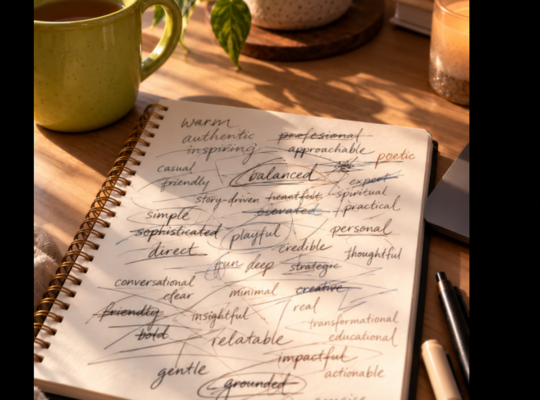
Start with what a Scribe is. Built well, it holds more than how you write. It covers who you are and how you sound, who you serve and what you know, how you want AI to work with you, and the details that make it unmistakably yours. That’s a solid core: your point of view, your frameworks, the stories you draw from.
But it’s still a core, built from what you chose to put in. It isn’t meant to hold every article you’ve written, every training you’ve taken, every source you trust. And on any given question, sounding like you doesn’t tell AI which of those things applies.
Three things from my own work back this up.
Fluency is not accuracy. In What Is AI Discernment?, I wrote that better AI sounds more convincing without necessarily being more correct. Confidence in the wording tells you nothing about whether it’s right.
What you give it is what it works from. In The Best Claude Setup for Founders, a useful Project holds three things: what you believe, what good looks like, and what to avoid. Examples teach it more than adjectives do. And more files is not more understanding. Focused material helps. A pile adds noise.
Your experience can’t be generated. In Turn Lived Expertise Into Authority, the point is that AI can organize and sharpen what you know, but it can’t live your experience for you. Your own truth goes in your voice. Anything beyond your direct experience needs a source you can check.
That’s why the research matters. The voice is how people recognize you. The research is what makes them right to trust you.
The Solution
Two weeks ago, The Friction Audit helped you find where AI is getting in your way. Last week, The Authenticity Chasm took the friction that feels like “this isn’t quite me” and answered it with a Personal Scribe built from your real writing. That article also named the AI Brain in one line. This week is the other half of the same idea.
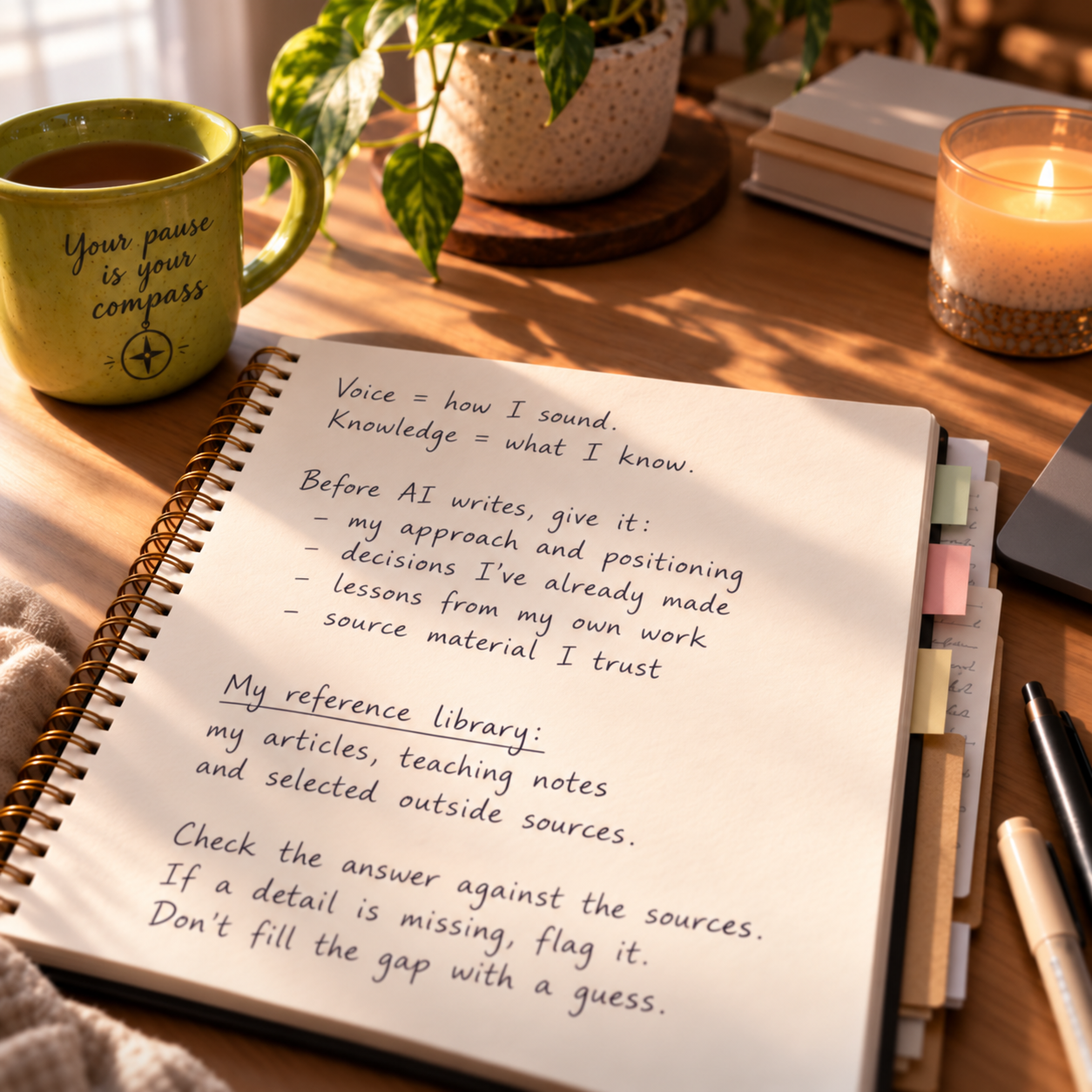
Your Scribe carries who you are: your voice, your point of view, who you serve and how you make decisions. Your AI Brain carries what you can point to: your own writing, plus articles, trainings and sources you’ve deliberately chosen to keep, each one tied to something you can cite.
The purpose of the AI Brain is to give AI more of your real material to draw on and check against, instead of starting from generic answers. It doesn’t guarantee a correct answer. You still check the sources and make the final call.
This is how I work on the AI Knowledge Library. Once I know the week’s topic, I go to my AI Brain and ask it to find everything I have on it. Then I look for current stats and data separately. The Scribe keeps it sounding like me. The AI Brain supplies what I actually know.
It doesn’t need to be big. Start with your own past articles and notes. Add outside material only if you’d stand behind it.
Practical Steps
- Pick one job you repeat, like a weekly newsletter or client follow-ups. Start there, not with your whole business.
- Gather what already exists: your own articles, notes, and the one or two frameworks you teach most.
- Add outside material only if you trust the source. Leave out anything you wouldn’t cite.
- Keep your personal truth and outside facts apart. Your experience goes in your voice. Statistics, studies and claims need a source.
- When AI answers, check it. Ask where a claim comes from. Ask what it left out. Then decide for yourself.
- When you correct the same thing twice, add the fix to your AI Brain.
If your Scribe already tells AI to flag claims it isn’t sure of, keep that. It helps. But a flag is not a fact. Your AI Brain gives it something real to check against, and your judgment makes the final call.
FAQ
Isn’t this the same thing as the Scribe?
No. Your Scribe carries your voice and the core of what you believe. The AI Brain is the deeper library of reference material behind it. A good Scribe with a thin AI Brain can still give you confident answers that don’t hold up.
Do I need to organize everything I’ve ever written?
No. Start with what’s already yours and add slowly. A small AI Brain you trust beats a big one you don’t.
What if I don’t have much written down yet?
Start with your Scribe, then add outside material you’d cite. The aim isn’t volume. It’s that everything in there is something you’d stand behind.
The Close
Voice helps people recognize you and start to trust you. Research and real knowledge are what make that trust deserved. You need both, and getting one doesn’t automatically give you the other.
If your Scribe is working but some answers still feel off underneath, that’s not a voice problem anymore. That’s the next thing to build, and it’s your AI Brain.
If you’d like to see how I think about building one, I put it on one page:

Your pause is your compass.
This is part of Agentic AI and the Human Advantage, a weekly series on staying the author of your own work as AI takes on more of the labor.
Sources
- What Is AI Discernment? A Founder’s Guide to Judgment, Not Just Output: https://omnimindfulness.com/what-is-ai-discernment-a-founders-guide-to-judgment-not-just-output/
- The Best Claude Setup for Founders: Start With One Project That Knows Your Work: https://omnimindfulness.com/the-best-claude-setup-for-founders-start-with-one-project-that-knows-your-work/
- Turn Lived Expertise Into Authority: The One Thing AI Can’t Write for You: https://omnimindfulness.com/turn-lived-expertise-into-authority-the-one-thing-ai-cant-write-for-you/