
What AI discernment means, why it’s the founder skill that matters most as AI gets better, and how to practice it on any tool.

AI discernment is the practiced judgment of deciding what to trust, keep, change, or reject in what AI produces — and staying the author of the final call. It is not distrust of AI, and it is not technical skill. It’s the human layer that sits on top of any AI tool: knowing that a fluent, confident answer is not the same as a true or right one, and having a repeatable way to tell the difference before anything you make goes out under your name.
Here’s why it’s the skill worth building now: as AI gets better, its output gets more persuasive, not more verified. The polish improves faster than the accuracy. That widens the gap between how right something sounds and how right it actually is — and discernment is what closes that gap. A founder with strong discernment can use almost any tool well. A founder without it can be quietly led off course by the best tool in the world.
Key Takeaways
- AI discernment is judgment, not distrust. It’s deciding what to trust, keep, change, or reject — and owning the final call.
- Fluency is not accuracy. Better AI sounds more convincing without necessarily being more correct.
- Discernment is tool-agnostic. It’s a human practice you carry to any AI, not a feature of one.
- The move is repeatable: verify what’s claimed, interrogate what’s missing, own the decision.
- The goal is amplification, not replacement. AI handles volume and speed; you keep meaning and accountability.
What AI Discernment Actually Is
Discernment is an old idea wearing new clothes. It has always meant the ability to perceive clearly and judge well — to tell the real from the merely convincing. Applied to AI, it’s the capacity to look at a fluent, well-formatted output and ask: is this actually true, does it actually fit, and do I actually agree — before I let it become part of my work.
It’s worth being precise about what discernment is not. It isn’t skepticism for its own sake; a founder who rejects everything AI produces gets none of the benefit. It isn’t prompt engineering; better inputs help, but the judgment happens on the output. And it isn’t a personality trait you either have or don’t. It’s a practice — a set of small, repeatable checks that get faster the more you use them.
I practice this most with Claude — it’s the tool I’ve built my own discernment habits around — but discernment isn’t loyal to one tool. It’s the human layer on top of all of them.
Why This Is the Founder Skill That Matters Most
Most founders meet AI at the point of overwhelm: too many tools, too much output, too little time to check any of it. The instinct is to either trust it all (and ship things you can’t stand behind) or trust none of it (and lose the leverage entirely). Both are failures of discernment, just in opposite directions.
There’s a quieter reason this matters, too, and it’s one Omni Mindfulness™ takes seriously: AI is fluent in a way that bypasses your critical attention. A confident paragraph slides past the part of you that would question a hesitant one. That’s not a flaw you can prompt away — it’s how persuasion works. Discernment is the deliberate re-engagement of attention that a smooth output is designed to relax. In a real sense, it’s a mindfulness practice pointed at a screen: notice, pause, then decide — rather than absorb and move on.
The Discernment Check: Verify, Interrogate, Own
This is the practice underneath the way I actually work. Three questions, applied to any AI output before you rely on it. Underneath runs the Omni rhythm — Pause → Reflect → Amplify.
AI discernment happens across three moments: what you choose before engaging a tool, what you do with the output you receive, and how you decide whether to apply it.
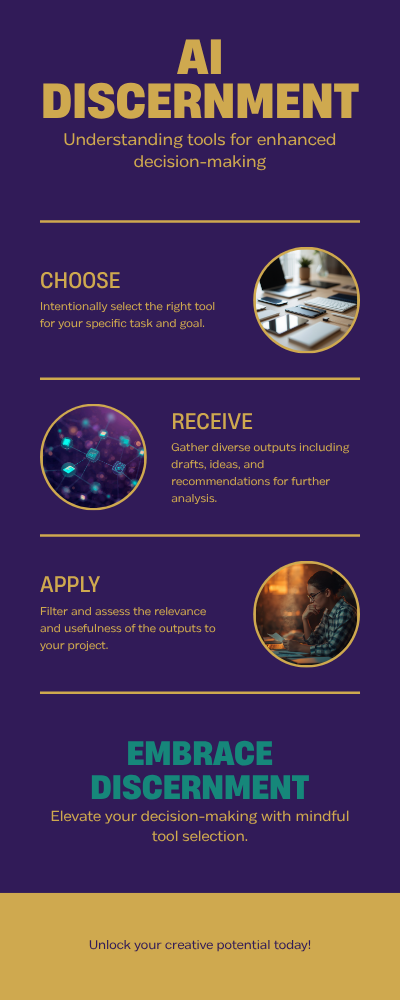
AI Discernment
The judgment inside those three moments is what makes discernment practical: verify what the output claims, interrogate what it misses or assumes, and own the final decision.
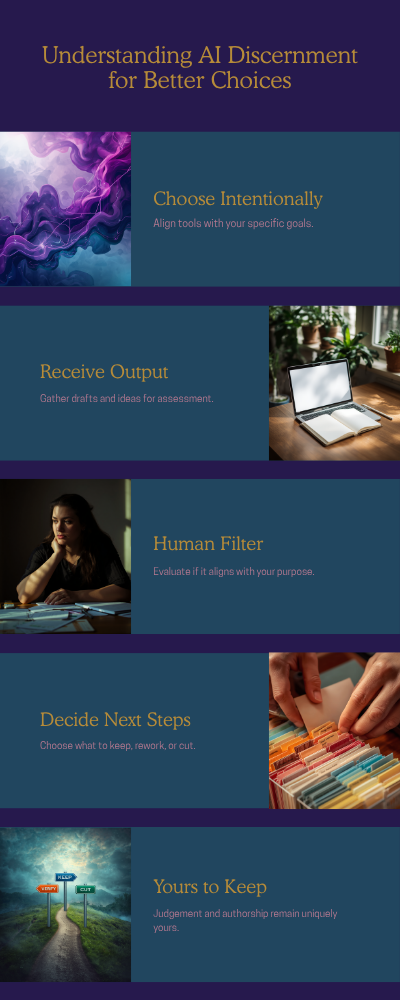
The judgment inside those three moments is what makes discernment practical: verify what the output claims, interrogate what it misses or assumes, and own the final decision.
1. Verify — is this actually true? (Pause.) Treat every factual claim as unconfirmed until you or the tool can show the source. Fluency is not evidence. Ask the tool to cite where a claim comes from, and check anything that will carry your name. Confidence in the wording tells you nothing about accuracy.
2. Interrogate — what does this miss, and does it fit? (Reflect.) Even an accurate output can be the wrong output — off-theme, missing context, or subtly reframing something in a way you don’t mean. Ask what it left out, what assumption it’s resting on, and whether it actually answers your question or a generic version of it.
3. Own — do I stand behind this? (Amplify.) The final call is yours. Keep what’s genuinely useful, change what’s close, cut what doesn’t hold — and take responsibility for the result as if no tool had touched it. Because as far as your reader is concerned, none did.
Practical Steps: Practicing Discernment on Any Tool
- Separate “sounds right” from “is right.” Before reacting to an output, name which one you’re responding to. The gap between them is exactly where discernment lives.
- Make the tool show its work. Ask for sources, reasoning, or the passage a claim came from. If it can’t show you, treat the claim as unverified.
- Ask what’s missing, not just what’s there. “What did you leave out?” and “What are you assuming?” surface the errors a clean output hides.
- Check it against what you already know. Your expertise is a sensor. If something reads slightly off against your lived experience, stop and investigate — that instinct is usually right.
- Keep the asked/kept/overrode habit. For anything meaningful, note what you asked, what you kept, and what you overrode. The overrides are your discernment made visible.
- Decide, then own it. Make the final call yourself and stand behind it fully. “The tool wrote it” is never an answer you’d want to give.
One Technical Tip
Give the AI tool a human lens before asking it to produce. Create a small reference file with your strengths, context, preferences, frameworks, examples, and boundaries, then place it wherever your chosen tool stores reusable context—such as a Project, Knowledge base, Gem, or reference-file area.
Claude is my own default for this — I keep a short Project knowledge file so it starts from my context instead of a blank page — but the same move works in any tool that stores reusable context.
This helps the tool understand what matters to you and what “good” looks like. But context is not proof: you still need to verify the claims, interrogate what is missing, and own the final decision.
What Discernment Looks Like in Practice
These are real moments from my own work — the check applied, not theorized.
Verify caught an off-theme fact. I brought a set of statistics into Claude and asked it to confirm they were real before I used them. It verified them through direct lookups — but one, though accurate, was about the wrong thing entirely, off-theme for the piece. Verified and cut. Accuracy passed; fit didn’t.
Interrogate caught a confident wrong story. I asked an AI to summarize a project’s status. It reported a problem confidently — except the story was wrong. I pushed back with the actual records, and it retracted. The lesson wasn’t “AI lies.” It’s that a confident summary still has to be checked against the source, every time.
Own kept the authorship with me. After that correction, I didn’t have the tool rewrite the document. I explained it in my own words. Some things you don’t hand back — the final account of what happened is one of them.
The Guardrail: What Discernment Protects
Discernment exists to keep five things in human hands: verification (deciding what’s true), judgment (deciding what matters), authorship (deciding how it’s said), taste (deciding what’s good), and accountability (owning the result). AI can assist every one of these. It can replace none of them without the work quietly stopping being yours. The point isn’t to use AI less. It’s to stay awake while you use it.
Frequently Asked Questions
What is AI discernment in simple terms?
It’s the judgment to decide what to trust, keep, change, or reject in what AI gives you — and to stay the author of the final decision. It treats a confident answer as a starting point to evaluate, not a conclusion to accept.
Is AI discernment the same as not trusting AI?
No. Refusing to use AI is as much a failure of discernment as trusting it blindly. Discernment is calibrated trust — extending exactly as much as the evidence supports, and no more.
How is discernment different from prompt engineering?
Prompt engineering improves the input. Discernment evaluates the output. Better prompts help, but the judgment about whether to trust and use a result happens after the tool responds — and that’s where discernment lives.
Do I need to be technical to have good AI discernment?
No. Discernment draws on your existing expertise and judgment, not on technical knowledge. If you can tell when something is off against what you already know, you already have the core instinct — the practice just makes it repeatable.
Why does AI discernment matter more as AI improves?
Because better AI produces more persuasive output, not necessarily more accurate output. Polish improves faster than truth. The more convincing the result, the more your judgment has to do — which makes discernment a rising skill, not a fading one.
How do I build discernment as a habit?
Run three questions on anything that matters — is it true, does it fit, do I stand behind it — and track what you keep versus override. Repetition makes it fast, until it stops feeling like a checklist and starts feeling like attention.
The Real Question
The better AI gets, the more the quality of your work depends on the quality of your attention. Tools will keep getting more fluent, more confident, more helpful-sounding. None of that removes the one thing only you can do: decide what’s true, what fits, and what you’re willing to put your name on. That decision is not a bottleneck to automate away. It’s the whole job.
So the next time an answer arrives polished and sure of itself, treat that polish as the beginning of your work, not the end of it.
Your pause is your compass. — Shilpa