
How founders can use AI for speed and support while keeping discernment, authorship, relationships, and final decisions human.

Staying human in an AI-first business does not mean using less AI. It means keeping authority over the work that matters most. Let AI organize, draft, summarize, compare, and carry repeatable labor—but keep responsibility for defining the problem, weighing the context, making the decision, and standing behind what happens next.
The useful boundary is simple: AI can assist with the doing. You remain responsible for the judging. That is how you gain speed without quietly handing over your agency, your voice, or the parts of your business that only you can hold.
For founders, coaches, and solopreneurs, this is not an abstract ethics question. It is a practical way of working. The more capable AI becomes, the more important it is to know what to delegate, what to review, and where you need to remain fully present.
Key Takeaways
- Staying human with AI is not about refusing useful tools. It is about keeping human discernment, context, ethics, authorship, and accountability in the places they belong.
- AI can carry repeatable, preparatory, and organizational labor; the founder should remain responsible for deciding what matters and what happens next.
- Human oversight is an established principle in major responsible-AI frameworks, including guidance from NIST’s AI Risk Management Framework, the OECD AI Principles, and UNESCO’s Recommendation on the Ethics of Artificial Intelligence.
- Fluent output is not verified output. AI can generate false, misleading, or unsupported information with confidence, which NIST’s Generative AI Profile identifies as a core risk that requires human review before anything becomes a decision, promise, or publication.
- The practical move is repeatable: Direct the work, Delegate the labor, and Decide the final call.
First, the Reframe
The question is not whether AI will replace human work. In many businesses, it is already changing how work gets done: drafts appear faster, meetings become summaries, research becomes synthesis, and a blank page becomes a list of options.
The more useful question is this: what should become faster, and what should remain yours?
AI can make a founder more capable when it takes on the labor around the work: sorting notes, organizing information, preparing an outline, identifying gaps, generating options, or turning a rough recording into a usable first draft. Those are meaningful forms of support.
But AI does not carry the consequences of a decision. It does not have your lived history with a client, your responsibility to your team, your understanding of a delicate relationship, or your obligation to stand behind a public claim. It can produce an answer. It cannot own what happens after that answer is used.
This is why staying human does not mean becoming anti-AI. It means becoming intentional about where AI belongs in the workflow.
Think of AI as a capable assistant preparing a briefing. It can gather material, sort the files, identify options, and make the first pass easier. But it does not decide the direction of the business. It does not sign the agreement. It does not repair the relationship if the wrong message goes out. The founder still holds the compass.
What “Staying Human” Actually Means
Staying human with AI means preserving your agency in the moments that require judgment.
This idea isn’t just personal preference — it’s a principle major AI-governance bodies agree on: a person, not the system, should stay in charge. The OECD AI Principles call for “human agency and oversight,” meaning people should be able to understand, question, and step in on what AI does. UNESCO’s Recommendation on the Ethics of AI frames it as human “oversight and determination” — the idea that humans, not machines, hold the final say over how AI is used. In plain terms: the tool can help, but you keep the authority.
In a founder’s daily work, that does not require a legal department or a complicated governance policy. It means knowing the difference between a task AI can support and a decision you need to own.
AI can help with:
- Turning notes into an outline
- Summarizing a long document
- Formatting information into a checklist
- Preparing options for a decision
- Identifying unanswered questions in a draft
- Comparing information against criteria you provide
- Creating a starting point for content, planning, or analysis
You remain responsible for:
- Defining the real problem
- Deciding which facts are reliable enough to use
- Understanding context that is not visible in the prompt
- Making ethical trade-offs
- Choosing what serves a client, team, or business relationship
- Determining whether the writing reflects what you genuinely believe
- Approving what is published, promised, sent, or acted on
This is not because AI is useless. It is because usefulness and authority are different things.
A calculator can complete arithmetic quickly. It cannot decide which problem is worth solving, whether the input is correct, or whether the answer makes sense in the real world. AI works similarly: it can accelerate parts of the process, but it cannot replace the person responsible for choosing the question, interpreting the answer, and accepting the consequences.
The Framework: Direct → Delegate → Decide
This is the human-led practice underneath the way I recommend using AI. Three moves, applied to any meaningful AI-assisted task. Underneath them runs the Omni rhythm: Pause → Reflect → Amplify.
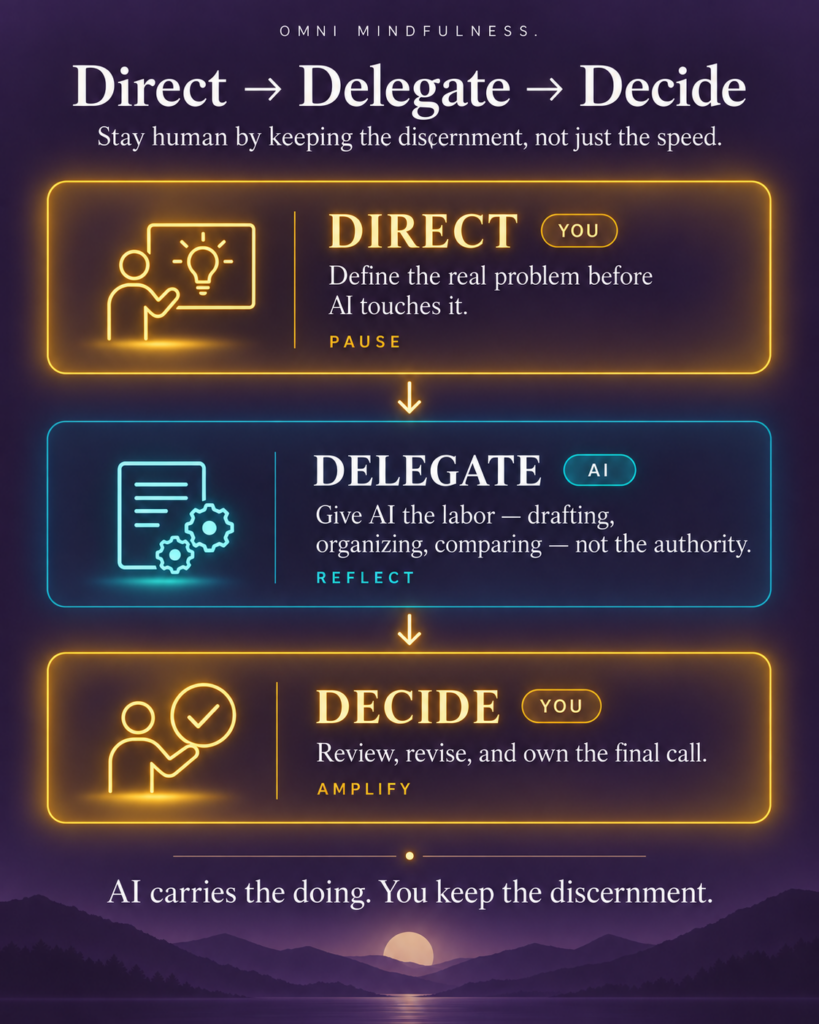
1. Direct — Define the real problem before AI touches it. (Pause.)
Before prompting, slow down long enough to name what you are actually trying to solve.
Do not begin with, “What should I do?” Begin with what you know:
- What outcome am I trying to create?
- Who is affected by this decision?
- What constraints are real?
- What information is missing?
- What values or relationships need to be protected?
- What would make this answer useful—not merely impressive?
AI can help you clarify a problem. It should not quietly redefine the problem and then offer a polished answer to its own assumption.
Try this prompt:
“Help me clarify this problem before suggesting solutions. Identify the assumptions I may be making, the context that is missing, and the questions I need to answer myself.”
That small boundary matters. It keeps the founder in the role of defining what matters before the tool begins generating possibilities.
2. Delegate — Give AI the labor, not the authority. (Reflect.)
Delegate work that is repeatable, preparatory, bounded, and reversible.
For example, AI can help you:
- Organize a set of client notes into themes
- Turn a voice memo into a first outline
- Prepare questions for a meeting
- Identify conflicting statements in a document
- Draft several possible structures for an article
- Summarize research you will later check
- Turn a rough process into a first-pass checklist
Be slower and more deliberate with work involving high stakes, personal consequences, legal or financial implications, safety, employment, health, sensitive relationships, or public claims you have not verified. The EU AI Act requires human oversight for defined high-risk AI systems, reflecting a wider governance principle: as potential harm rises, meaningful human review matters more.
A helpful question is:
“Would I hand this task to a smart new hire on their first day without reviewing it?”
If the answer is no, do not hand it to AI without meaningful review either.
3. Decide — Review, revise, and own the final call. (Amplify.)
Before AI-assisted work becomes an action, decision, client communication, public claim, or published piece of content, return to your own judgment.
Ask:
- Is this true enough to rely on?
- Does it fit this specific situation?
- What is it assuming, generalizing, or leaving out?
- What could happen if this is wrong?
- Does this sound like me and reflect what I actually mean?
- Would I stand behind this if no one knew AI had helped?
This is the point at which AI becomes genuinely useful rather than quietly controlling. You keep what helps. You edit what is close. You reject what does not hold. You make the final decision as if the work will carry your name—because it will.
NIST’s Generative AI Profile identifies “confabulation”—the production of false or misleading content presented with confidence—as a key generative-AI risk. That does not mean every output is wrong. It means confidence is not evidence, and review is part of responsible use.
Practical Ways to Apply This
Use draft-only mode before you automate. When you are testing a new AI workflow, ask for drafts, options, summaries, and recommendations—not automatic changes. Expand its role only after you understand what it handles well, where it misses context, and what needs your review.
Create an “Open Questions” lane. Tell AI to identify ambiguity rather than hiding it behind a plausible answer. For client notes, plans, research, or project briefs, ask the tool to create an “Open Questions” section whenever the source material does not support a firm conclusion.
Write the decision criteria yourself. Before asking AI to compare options, decide what matters. Cost, client impact, ethical risk, strategic fit, time to implement, reversibility, and relationship implications are human criteria. AI can help analyze options against them; it should not decide them for you.
Keep one important thinking step manual. This is not a purity test. It is a skill-preservation practice. Draft the first paragraph before asking for alternatives. Outline the decision before asking AI to challenge it. Name your initial point of view before AI offers its own. When AI always supplies the first thought, notice whether you are practicing your own reasoning less often.
Use AI as a stress tester, not a substitute for thought.
Instead of asking, “What should I think?”, try:
“Here is my current position. What assumptions is it resting on? What would a thoughtful critic challenge? What evidence would change my mind?”
This keeps the tool in a supportive role while strengthening your own reasoning.
One Technical Tip Worth Knowing
For meaningful recurring work, build one instruction into your AI workspace:
“When the source material is unclear, incomplete, or contradictory, do not guess. Flag the issue under ‘Open Questions’ and tell me what information is needed to decide.”
This is especially useful in Claude Projects, ChatGPT projects or custom instructions, reusable prompts, and shared team workflows. The specific feature will differ by tool, but the principle is the same: make uncertainty visible instead of rewarding AI for sounding certain.
Use this instruction for project briefs, client handoffs, research summaries, content planning, meeting notes, and business decisions. It creates a clear handoff point between machine assistance and human discernment.
AI should be allowed to say, “I do not have enough information to conclude.” A system that surfaces uncertainty is safer and more useful than one that fills every gap with a confident sentence.
Guardrails and Honest Limits
Do not mistake fluency for truth. A polished answer can still be incomplete, off-context, or false. Verify facts, especially when they affect clients, money, health, safety, compliance, legal obligations, or public trust. NIST’s Generative AI Profile identifies several risks that organizations should manage, including confabulation, harmful bias, information-integrity risks, and over-reliance by users.
Do not assume AI always causes skill loss. Using tools to reduce repetitive labor can be helpful. But if AI consistently performs a thinking step you need to remain capable of doing, it is worth noticing what you may be practicing less. Keep participating in the skills that support your expertise, decision-making, and professional responsibility.
Do not outsource authorship. AI can help shape a draft, but it cannot know whether an opinion is honestly yours, whether a story needs more context, or whether a sentence represents your values. If you are publishing work you have not really read, revised, or agreed with, the boundary has slipped.
Do not let the tool define the stakes. AI can produce options based on the information it sees. It cannot know every consequence, power dynamic, relationship history, or cultural nuance that may matter. Bring the real-world context yourself.
Do not confuse faster with better. Speed is valuable when it creates more room for high-impact work, reflection, relationships, and rest. It is not valuable when it removes the attention required to make a sound decision.
Frequently Asked Questions
Does staying human with AI mean I should avoid automation?
No. It means using automation intentionally. Automate repetitive, structured, low-stakes work where you can review the result. Keep human leadership in decisions that require discernment, context, ethics, relationships, and accountability.
What is human-in-the-loop AI?
Human-in-the-loop means a person remains involved in guiding, reviewing, approving, or overriding an AI system’s output. The level of involvement should increase as the task becomes more consequential. Human oversight is a central principle in responsible-AI guidance from institutions including the OECD and UNESCO.
What is automation bias?
Automation bias is the tendency to place too much trust in an automated recommendation or output, especially when it appears efficient, neutral, or confident. In practice, it can look like accepting an AI summary without checking the source, following a recommendation without examining its assumptions, or publishing a polished draft without restoring your own judgment. NIST’s Generative AI Profile includes automation bias and over-reliance among the human-AI risks organizations should manage.
What kinds of work should I not hand to AI alone?
Do not rely on AI alone for high-stakes legal, medical, financial, safety, hiring, employment, access, compliance, or sensitive relationship decisions. AI can help prepare information and identify questions, but qualified humans should make and review consequential decisions.
How can AI make me faster without making my work generic?
Give AI the repeatable labor: organizing, drafting, reformatting, summarizing, and preparing options. Keep the human voice-pass: restore your lived examples, perspective, nuance, and actual judgment before anything is final. AI can make the path to a first draft shorter; it cannot replace the specific person behind the final work.
Speed Is Useful. Agency Is Essential.
The future does not belong to the founder who uses the least AI, or the founder who automates the most.
It belongs to the founder who can use powerful tools without becoming absent from her own work.
Let AI carry the repeatable labor. Let it organize the mess, prepare the first pass, reveal patterns, and create more room for the work that needs you.
But stay close to the decision. Stay close to the relationship. Stay close to the question of what is true, what matters, and what you are willing to put your name behind.
Speed is useful. Agency is essential.
If you want a clearer way to protect your discernment and voice while using AI, the next step is not another prompt library. It is building an AI practice that supports the human running the business. In the Amplify You™ Workshop, we build a practical human-led workflow around your real work: what to delegate, what to keep, and how to use AI as a thinking partner without letting it become the author of your business.
If AI is helping you work faster but your business still feels scattered, the problem may be larger than one tool or one workflow. Take the free Streamline State Audit to see where friction is quietly costing time, focus, and momentum. You can also explore the rest of the AI Knowledge Library for grounded, practical guidance on using AI with more clarity, authenticity, and purpose.
What if AI could sound like you — not a robotic stranger?
Build your Personal Scribe with me, live. →

Sources
- NIST AI Risk Management Framework 1.0 — January 2023
- NIST AI 600-1: Artificial Intelligence Risk Management Framework: Generative Artificial Intelligence Profile — July 2024
- OECD AI Principles — updated May 2024
- UNESCO Recommendation on the Ethics of Artificial Intelligence — adopted November 2021
- European Commission: Regulatory Framework for Artificial Intelligence — AI Act entered into force August 1, 2024