
Foundations First: knowing what your business stands for before AI speaks for it.

Since yesterday morning, I’ve been preparing to introduce my updated services page, including my Amplify You Studio, my new AI visibility studio, built around three pathways: Learn, Build, and Show Up.
Getting here took a pause. As I shaped the offerings, I kept circling the structure: what order made sense, what needed to come first.
Just as I landed on a direction, I read a post by Alex Sanfilippo, founder of PodMatch. His reflection on tending to our inputs, rather than becoming constant output machines, resonated with me. I responded because it connected with the heart of my work: bridging AI and mindfulness.
Here is what I kept circling back to: a tool can only draw on what it can reach. Before AI speaks for your business, know what you want it to say. Know thyself first. Then know your business.
Meditation and journaling give us space to pause, reflect and become more aware of who we are. Know thyself. That same reflection belongs in our businesses, too. Beyond what we offer and how the business runs, what is it here to express? Whom do we want to serve, and what impact do we hope to have? Does the way we show up reflect our values, or only the mechanics of doing business?
Know thyself. Then bring that same depth of understanding to your business. Before asking AI to speak or act on its behalf, get clear on what you want it to stand for.
Key Takeaways
- If AI keeps missing the mark on your business, check the foundation before the prompt: the knowledge the tool needs may still live only in your head.
- Struggling to put your business into words is not a lack of intelligence or vision. Meaning often runs deeper than language, especially when you wear every hat.
- The same reflection that builds self-knowledge in meditation or journaling can extend to your business: your voice, your values and the impact you want to have.
- Three foundations carry your business into AI: your voice, your customer and your business context itself.
- Context gives AI a clearer starting point. It does not end guessing or guarantee consistency, and it never replaces your judgment.
The Problem
If you have used AI for anything that touches your business, you may know this rhythm. You ask for something simple, a product description or a reply to a customer, and what comes back is technically fine. Grammatically clean. Pleasant, even. And not yours.
So you correct it. You explain that your signature offer is not a “program,” that you serve people, not “companies,” that you would never promise transformation in thirty days. The tool adjusts in the moment, and the correction doesn’t always stick. Another week, another version of the same fix.
The misses can seem small. A tool describes your coaching as “content creation,” or your retreat as an “event.” Each one is minor. Together, they add up to a business that isn’t quite yours.
When that loop keeps repeating, one cause worth checking sits underneath it: the tool is missing your foundation. Not cleverness. Your foundation: the knowledge of your business that you have never fully said out loud. It lives in your head, in your decisions, in the thousand small nos and yeses you have given over the years. Until it exists somewhere the tool can reach, the tool is left to guess.
The cost runs deeper than retyping. Every generic draft that ships under your name can teach your audience a slightly wrong version of you. And every hour spent re-explaining is an hour the tool was supposed to hand back.
And here is something I want to say plainly, because it matters. Struggling to put your business into words does not mean you lack intelligence, depth or mission. Most small business owners wear every hat at once. Many are working in a second language, where the meaning is fully alive but the words arrive slower. The purpose can be deeply understood and still hard to express. Those are different things, and confusing them keeps too many good business owners quiet.

The Evidence
There is some data behind the timing of this conversation. In Goldman Sachs 10,000 Small Businesses’ October 2026 report, 86% of graduates report using AI in their business, up from 56% just two years ago. Yet only 15% have fully integrated AI into their core operations, and the share using AI to write marketing content has actually declined since 2024, from 74% to 65%, as owners move toward deeper uses like data analysis. The report’s own conclusion: the gap between adoption and integration is now the defining frontier for small businesses.
The survey doesn’t say what closes that gap. My read, from my own work: depth needs something the tool can draw on, and that something is the foundation this article is about.
Here is a small, real picture of what a foundation looks like. Take Allie Thornton’s eco-jewelry: ethically harvested rainforest materials, and livelihoods for the artisans in Ecuador who make it. A description that stops at “beautiful jewelry” leaves most of that meaning untold.
I have watched the same pattern from the other side, in this series. In The Authenticity Chasm, the gap was voice: describing your style and actually sounding like yourself are different things. In The Expertise Chasm, it was knowledge: what you know versus what the tool can reach. This article is about the third chasm, the one underneath both: your business itself.
One honest note: beyond the Goldman Sachs report above, this piece draws on my own experience rather than external studies. I would rather tell you that plainly than dress anecdote up as data.
The Solution
So what helps close the third chasm? A deeper pause.
I want to be careful not to turn this into a formula, because it is not one. It is the same practice my work has always begun with: pause first, reflect deeply, amplify what matters. Applied here, it simply asks you to pause over your business before you ask technology to carry it.
This is also the work beneath branding. Good branding includes discovery and strategy; a thoughtful designer will ask many of these same questions. The point is the order of the work. Depth comes before visible choices, because no expression, however skilled, can substitute for your own clarity about what the business stands for.
In practice, that understanding settles into three foundations:
Your voice. The way you actually sound, drawn from your real writing, not from adjectives you hope describe you. This is what my Personal Scribe course builds, and it is available now.
Your customer. Whom you serve, understood through what I call the 3A framework: their Aspirations, their Aches and their Apprehensions. A new version of my ICA Builder, which walks you through exactly this, is coming soon.
Your business context. Your purpose, offers, distinctions and boundaries, connected into one working picture your tools can draw on. A builder for this is available now as well.
In the suite’s language, these foundations are where the Learn and Build pathways begin. And because a foundation only matters if it gets used, the Show Up pathway supports what comes after: content, visibility, video and podcasting, expressing the business once you know what it is.
Each foundation stands alone, and they compound. Start wherever the gap feels loudest. And none of it requires buying anything before you begin: writing your answers in a notebook tonight already puts you ahead of where you were this morning.
Two honest notes, because trust matters more than enthusiasm. Giving a tool your foundation is not the same as handing it your judgment: context tells AI what you stand for, and you still decide what it may do and when it must stop and ask. And context helps rather than guarantees. It gives AI a clearer signal and a better starting point, not an end to guessing, not a promise of consistency, and never a substitute for your judgment about what is true.
Practical Steps
Pause
- Notice the repeats. Watch what you keep re-explaining or correcting this week; each one can point to something your foundation has not covered yet.
Reflect
- Write the correction down. Take the one you give most often and put the accurate version beside it. One line is a first stone.
- Sit with the bigger questions. Whom do you serve? What do you stand for? Where are your lines? Short, honest answers beat polished ones.
Amplify
- Capture it somewhere you own. One durable document, not scattered chat histories.
- Load it deliberately. Add it to the tools you actually use; each platform handles context differently, so set it up rather than assuming it follows you.
- Give it a rhythm. A revisit you will actually keep – quarterly is one option – so you can update it as your business moves.
Frequently Asked Questions
Do I need all three foundations before I use AI at all?
No. Use AI wherever it helps today. The foundation matters most when the work touches your customers and your name.
Isn’t this just branding?
Good branding includes discovery and strategy, and a strong process will ask many of these same questions. The point here is order: depth before visible choices. Whether you work with a designer or on your own, the understanding has to be there to express.
How is this different from a style guide?
A style guide can guide voice and presentation. Business context adds the substance behind those choices: Business context covers what you stand for, whom you serve and where your lines are. Voice is one foundation of three.
The Close
As I prepared to introduce something new, the pause itself turned out to be the answer. The structure I was looking for was not in the offerings. It was underneath them. Foundations first.
In that same pause I was also asking what we do with the time these tools hand back: whether reclaiming it might help us reconnect with who we are. I believe the answer starts here, with a business that knows itself.
Teaching AI your voice was the first chasm. Giving it your expertise was the second. The third is the foundation under everything you build next: your business, articulated and unmistakably yours. Know thyself, before your business, and everything it builds, can know you.
Next week, I will get practical: what actually goes into that business context, and how a guided interview can draw out what you have never written down.
Your pause is your compass.
This is part of Agentic AI and the Human Advantage, a weekly series on staying the author of your own work as AI takes on more of the labor.
Amplify You Studio is open: my AI visibility studio, with ways to learn, build and show up, whatever your next step is. The Personal Scribe course and the Business Scribe Builder are available now; the ICA builder joins soon, and the waitlist is open. If you are preparing to hand AI bigger work, these foundations are what it leans on.
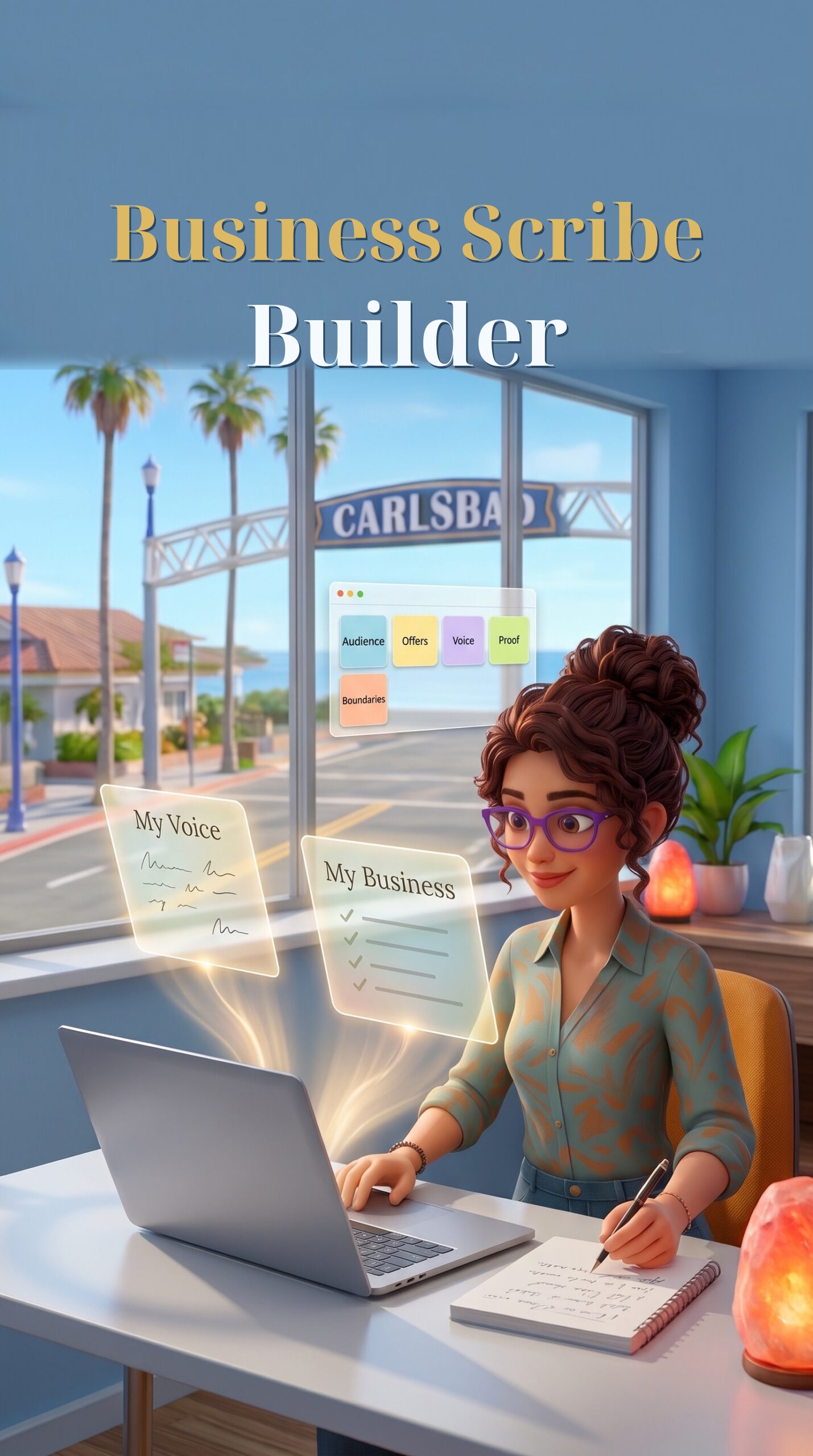
New this week: the Business Scribe Builder is live! It’s a guided interview that captures what you offer and what makes your business yours, so your AI can speak for your business, not just sound like you. You can find it on my updated services page, along with everything else that’s new.
Sources
- Goldman Sachs 10,000 Small Businesses: The AI Economy Is a Small Business Economy (October 2026): https://d3cobg6h0snvt3.cloudfront.net/pdfs/community-transformation/small-business-ai-institute/ai-impact-report.pdf
- Allie Thornton interview, SDVoyager (September 2026): https://sdvoyager.com/interview/life-work-with-alessandra-thornton-of-san-diego/
- Earlier in this series: The Authenticity Chasm: https://omnimindfulness.com/the-authenticity-chasm/ and The Expertise Chasm: https://omnimindfulness.com/the-expertise-chasm/