
On grief, entrepreneurship, meditation, and learning to surrender the outcome without abandoning the intention.
Years ago, I found myself sitting in a corporate meeting room, grieving.
I’d lost my mother, and the grief ran so deep that the closest analogy I can find is having sandpaper scraped against my heart.
I was functioning. Working. Showing up for meetings. Doing what we do when life demands that we carry on, even when something inside us feels profoundly unsettled.
Somewhere in the middle of that grief, I started slipping away from my workday to attend meditation sessions offered by my employer.
I remember the woman who led them.
She seemed so serene in her comfortable, almost Zen-like clothing. She’d hand out her flyers, settle into the room, and guide a handful of us who had given up part of our lunch break to find a little peace.
There was something about her presence.
She appeared to have mastered something I had spent much of my life trying to understand.
And that was particularly interesting because I’d grown up around meditation and spiritual teachings. Meditation wasn’t foreign to me. Yet knowing about something, even growing up with it, isn’t the same as embodying it.
I certainly didn’t feel I’d mastered inner stillness.
But something else about this woman fascinated me.
When our session ended, we’d return to our cubicles, meetings, and deadlines.
She’d leave.
You see, she wasn’t a corporate employee. She was an independent meditation teacher hired to guide us.
In my mind, she had figured out something rather extraordinary.
She was doing meaningful work, seemingly on her own terms.
And I wanted that freedom.
The dream wasn’t new. The direction was.
Throughout my professional life, I’d never felt entirely at home in the traditional nine-to-five world.
Cue Dolly Parton’s 9 to 5.
Don’t misunderstand me. I’ve loved many aspects of my career in technology. The creativity, the problem-solving, the possibilities. Technology has always fascinated me.
But there was a recurring question underneath it all.
Could I build something of my own?
And more importantly, could I build something that gave me greater freedom over how, when, and where I worked?
That question had been following me for years.
The independent meditation teacher I’d encountered during those lunchtime sessions planted an important seed. A few years later, I discovered meditation coach Sera Flow, whose entrepreneurial journey gave that idea further shape.
I began envisioning a professional life built around three things.
Location independence: The freedom to work on my own terms, from anywhere in the world.
Evergreen content: Creating original teachings, courses, and resources that could continue helping people long after I’d created them.
Passive income: Developing revenue streams from that original evergreen content, rather than depending entirely on trading my time for money.
It wasn’t that I wanted to stop working.
Quite the opposite.
I wanted to create something meaningful, something I could genuinely call my own, while having more freedom to decide how I spent my time and energy.
Of course, having a vision and knowing how to build it are two very different things.
I’d already experimented with entrepreneurship.
In fact, I spent more than two years exploring the idea of launching a catering business.
I love cooking, creating, and bringing people together through food. I wondered whether catering might be the perfect way to combine those gifts.
My husband, Rich, was immensely supportive. He designed a beautiful henna-inspired logo and would come along to events where I’d experiment with selling my chutney sandwiches.
It wasn’t necessarily his dream. It was mine. But he encouraged me as I tried to figure things out.
And for a while, I thought perhaps that was my path.
Yet catering, as much as I loved the creative side, was also physically demanding and tied to particular places, events, and hours.
I was beginning to recognize that the business I created needed to align not only with my interests but with the life I hoped to live.
Eventually, after considerable soul-searching, I began wondering whether meditation and life coaching might offer another direction.
And in one of life’s curious moments of timing, I began my meditation and life coach training just as the world was about to shut down in 2020.
I hadn’t anticipated the lockdown.
I certainly didn’t have a grand plan.
I still had a foot firmly planted in the corporate technology world, working remotely as an outside contractor.
I didn’t know whether meditation coaching would become a livelihood, how I’d make it work financially, or whether I could bring together the different parts of myself without abandoning the work I genuinely loved.
But the vision was becoming clearer.
I wanted to build something that could bring together my experience in technology, my spiritual practice, my creativity, and my desire to help others.
And I wanted to build it intentionally, with greater freedom over my time, my location, and the work I chose to create.
Planting a seed during an uncertain time
As part of my meditation teacher certification journey, I created something called the Collective Consciousness Circle.
It was a space to gather, meditate, and explore the possibility of becoming more conscious of how we move through life.
Over time, my work evolved.
Omni Mindfulness™ began taking shape at the intersection of meditation, mindful technology, personal growth, and eventually AI.
I became increasingly interested in helping people, particularly founders and independent professionals, use technology without becoming overwhelmed or losing the human qualities that make their work meaningful.
The Circle eventually went quiet.
But the idea never entirely disappeared.
And recently, I decided it was time to bring it back.
Years later, I opened the Circle again
On Monday, October 5, I hosted the first gathering of the relaunched Collective Consciousness Circle.

My vision was to create something more than a place to meditate.
I wanted it to be a space for contemplative reading and deeper conversations about consciousness, spirituality, and the nature of reality. A place to explore questions together, without pretending we already have all the answers.
For our first month’s reading, I selected The Zen Entrepreneur & the Dream, a newly released follow-up to Rizwan Virk’s Zen Entrepreneur.
Earlier this year, my curiosity about the simulation hypothesis and the ancient concept of māyā had led me to take one of his online courses and eventually invite him onto my podcast.
So when his new book appeared just as I was relaunching the Circle, it seemed like a fitting place to begin.
I’ve barely started reading it myself. But that’s part of the intention: to create a space where curiosity, reflection, and personal exploration can coexist.
And there was another dimension to this relaunch.
These days, I’m balancing quite a few moving parts as I continue building Omni Mindfulness™.
Alongside meditation and mindfulness coaching, I’m developing workshops, services, and digital products that help founders and independent professionals work more consciously with AI.
Much of that work centers on three interconnected goals: helping people streamline their work, elevate their distinctly human strengths, and amplify their authentic expertise without losing themselves in the technology.
I’m also writing, creating educational resources, producing podcast conversations, and exploring ways to turn my original teachings and intellectual property into evergreen content that can generate passive income.
I’m not there yet. Much of this is still being developed, tested, and refined.
And I continue to navigate the very real tension between creating meaningful work, protecting my energy, and generating the income necessary to sustain the business.
Some days, it’s an extraordinary privilege to pursue all these interests.
Other days, it’s a lot to carry.
Which is why I’m becoming increasingly deliberate about managing my energy, protecting time for income-generating work, and paying attention to my own STATE.
The Circle matters to me, but so does making a living. I’m learning to honor both without allowing either to overwhelm the other.
I had prepared for the relaunch.
Created the materials.
Shared invitations through my newsletter and social media.
Thought about how the Circle could become a welcoming introduction to meditation and perhaps, over time, help people discover my coaching, courses, or other services.
Because I am building a business.
And while I believe deeply in making meditation accessible, I also have to make a living.
I don’t think those intentions are incompatible.
So I did what any reasonably conscientious entrepreneur would do.
I prepared, promoted, and showed up.
And guess how many people attended?
One.
One person from my network.
And I was genuinely grateful she chose to spend that time with me.
We had an opportunity to pause, meditate, and connect. After all, wasn’t that part of why I’d created the Circle in the first place?
Still, I’d be less than truthful if I said I hadn’t imagined more people attending.
And that’s where the real reflection began.
Not because one person wasn’t enough.
But because I noticed the expectations I’d quietly carried into the experience.
Now, the strategist in me could immediately begin analyzing the outcome.
Was lunchtime inconvenient?
Did I promote it enough?
Was the invitation compelling?
Should I change the format?
Those are legitimate business questions.
But something else occurred to me.
When did we become so accustomed to measuring everything that we sometimes forget why we began?
One attendee.
One registration.
One comment.
One person who notices.
It’s remarkably easy to allow numbers to become judgments about the value of our work.
And perhaps, if we’re not paying attention, judgments about ourselves.
What years of meditation are teaching me about STATE
Here’s where my own meditation journey becomes relevant.
These days, I have a much more intentional practice than I did when I first encountered that woman in the corporate meeting room.
Kriya Yoga is central to my spiritual practice. I also spend time cultivating concentration, stillness, receptivity, and awareness.
But one of the most meaningful changes has been something I call my daily STATE reflection.
Each morning, I pause to notice my internal condition.
Am I peaceful?
Restless?
Anxious?
Grounded?
Emotionally reactive?
Physically tired but mentally calm?
I give myself a conservative assessment, usually on a scale of one to ten, and observe whether meditation shifts anything.
Some mornings, I begin restless and end deeply peaceful.
Other mornings, I practice faithfully and feel little noticeable change.
And some days, life presents circumstances that test whether any of that inner work is actually becoming part of how I live.
I’m increasingly realizing that the goal isn’t to experience a perfect meditation every morning.
It’s to cultivate a steadier inner condition that accompanies me beyond meditation.
Can I remain grounded when something disappoints me?
Can I recognize an emotional reaction before it takes over?
Can I distinguish what I can influence from what I cannot control?
Can I make a conscious choice rather than automatically following an old pattern?
That’s the work.
And it’s ongoing.
Surrender isn’t the absence of effort
Recently, I’ve been reflecting on a teaching associated with Paramahansa Yogananda about releasing our expectations and surrendering our attachment to outcomes.
It’s a particularly timely contemplation.
Because there’s a difference between intention and expectation.
Intention guides our effort. Expectation can become a demand that life unfold according to our preferred script.
I can plan a meditation gathering thoughtfully.
I can promote it.
I can learn from the response.
I can improve the invitation, experiment with how I communicate its value, and continue building relationships.
Those things are within my influence.
But I cannot control who attends.
And if I allow the number of attendees to determine my inner peace, I’ve handed something deeply personal over to circumstances I cannot fully control.
That doesn’t mean pretending disappointment doesn’t exist.
Nor does it mean ignoring the practical realities of running a business.
It means noticing the disappointment without automatically turning it into a story about failure.
This is something I return to in my own spiritual practice.
An affirmation from Yogananda that has long been meaningful to me begins:
“I will reason. I will will. I will act.”
I love that it emphasizes action.
Surrender doesn’t mean doing nothing.
It means bringing our reasoning, will, and actions into alignment with something greater than our immediate desires, while loosening our insistence on controlling the result.
And perhaps that’s one of the more difficult lessons of entrepreneurship, too.
We can do everything thoughtfully and still not receive the response we hoped for.
The question becomes: What do we do with that experience?
The person who showed up
I’ve been thinking again about that independent meditation teacher from years ago.
She probably never knew how much those lunchtime sessions meant to me.
She couldn’t have known what I was carrying emotionally after losing my mother, or that I was quietly imagining a different professional future.
To her, I may simply have been another person attending a meditation session.
But something about her presence stayed with me.
A seed was planted.
And years later, here I am, offering a meditation Circle of my own.
I’m grateful to the woman who joined me for our first gathering.
I don’t know what the experience meant to her. I don’t know whether she’ll return, whether more people will eventually join, or what the Circle will become.
And perhaps I don’t need to know all those answers today.
I’ll continue learning, refining, and building my business. I’ll continue exploring how meditation, consciousness, and technology can help us live and work with greater intention.
And I’ll continue practicing the very thing I’m trying to share with others: the ability to act wholeheartedly without allowing expectations to dictate my inner peace.
Years ago, I was the person sitting in that corporate meeting room, searching for a little peace and perhaps a different way of living.
Today, I’m still learning.
Still building.
Still practicing.
And perhaps becoming a little more comfortable with not knowing exactly how everything will unfold.
We don’t always know what our presence means to the one person who shows up.
And perhaps we don’t always know what a seemingly small beginning will become.
With a mindful pause,
Shilpa
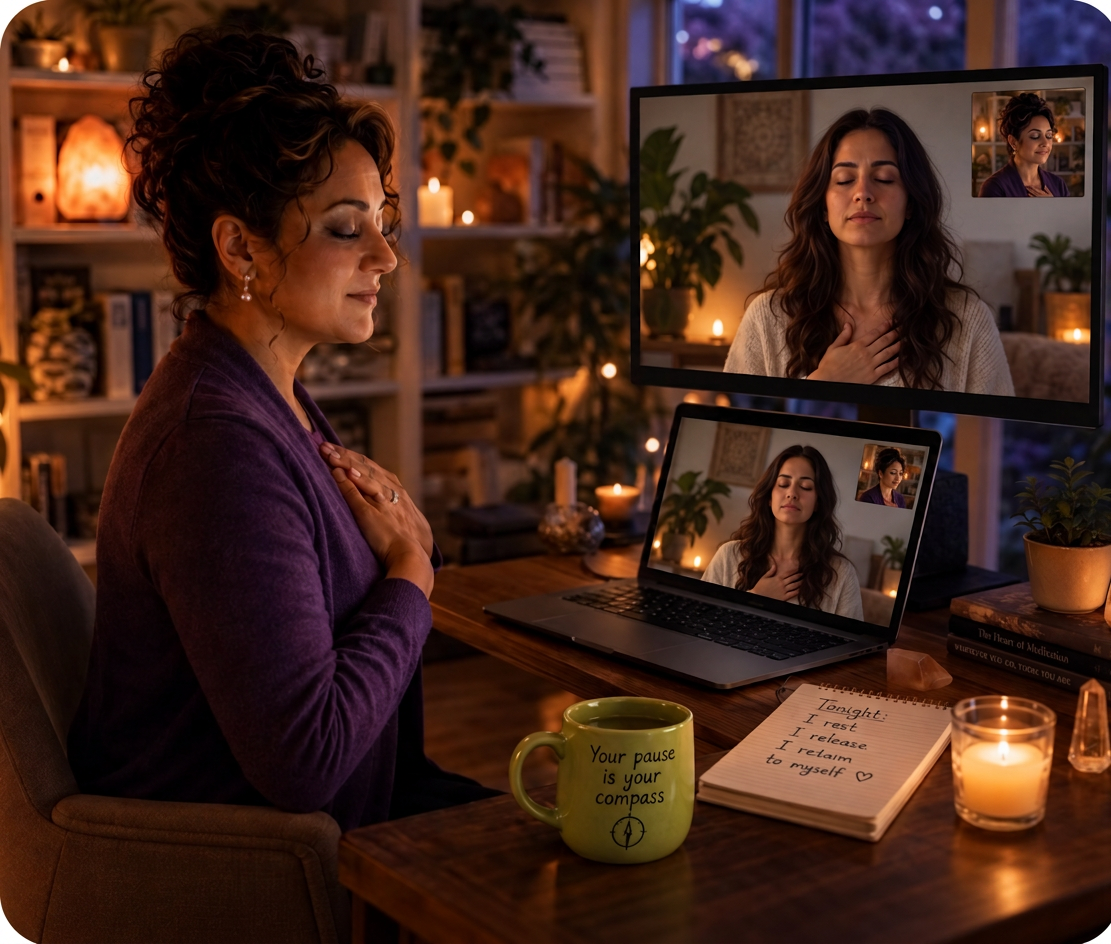
Your pause is your compass.
An invitation to pause with us
I’ve recently relaunched the Collective Consciousness Circle, a welcoming space to step away from the noise, practice meditation, and explore deeper questions about consciousness and everyday life through contemplative reading and conversation.
There’s no need to be an experienced meditator. Come as you are.
Explore the Collective Consciousness Circle →