
Why better AI results almost never come from a better tool — they come from closing the clarity gap only you can close
When I first started using ChatGPT, the advice I got was simple: get familiar with it the way you’d get familiar with anyone — have daily conversations with it. I took that more literally than expected and gave it a name: Chatty — my endearing nickname for ChatGPT, and my brilliant new sidekick ever since.

Then, in 2023, a fellow coach suggested exactly what I needed to hear next, and I still got it wrong. “You need to give it your content to get content,” they said — so I handed Chatty an entire article I’d written, hit enter, and waited to see what would happen. I genuinely didn’t know. The thread crashed. I remember feeling intimidated, like I’d broken something that was supposed to be simple.
I hadn’t broken anything. I’d just handed it a pile of words with no actual ask attached — no context, no direction, no sense of what “good” meant for that piece.
Here’s the direct answer, before we go any further: the gap between a flat AI output and a sharp one is almost never the tool. It’s clarity — the role, the real context, and the specific goal you hand it before you ever hit enter. Everything else in this letter is just the practice of closing that gap.
Key Takeaways
- A vague prompt produces a vague answer for a structural reason: there’s nothing specific in the ask for the AI to amplify. AI enhances expertise — it doesn’t invent it.
- A 2025 study testing structured prompting found quality gains of up to 47%, sharpest in creativity and originality — the mechanism is real, not a productivity myth.
- The fix isn’t learning “prompt engineering” as a new skill. It’s bringing the same clarity to a chat window that you’d bring to briefing a real consultant sitting across from you.
- A simple three-part practice — role, context, goal — closes most of the gap on its own, without memorizing a framework.
- Clarity is a discipline, not a personality trait. It’s built the same way any discipline is: in small, repeated practice.

YOU’RE NOT BEHIND. YOU’RE JUST DOING THIS ALONE.
The Problem
Most founders I talk to have a version of my 2023 story. They open an AI tool, type something flat and rushed, get something flat and generic back, and quietly conclude the tool isn’t very good — or that everyone else seems to have figured out some trick they haven’t.
That belief is doing real damage. It sends people down a rabbit hole of “prompt hacks” and cheat sheets, treating AI like a new piece of software with secret keyboard shortcuts to memorize. It’s also exhausting in a specific way that overwhelm always is: not because the work is hard, but because the actual problem was never named. You can’t fix a clarity gap by researching more tools. You fix it by getting clearer about what you’re actually trying to solve — the same discipline that shows up on the meditation cushion, noticing what’s actually happening instead of what you assume is happening, is the discipline this asks of you at a keyboard.
But what if the fix isn’t a smarter tool, or a longer list of tricks? What if it’s ten seconds of clarity before you type a word?
The Evidence
The data backs up what shows up anecdotally in almost every founder conversation I have. A 2025 study out of the International Journal of Innovative Research and Scientific Studies tested a structured prompting framework against traditional, unstructured prompting across a sample of participants. The result: structured prompts improved output quality by 18.4% to 46.8% across measures like relevance, coherence, and tone — with the single biggest gain, nearly 47%, showing up in creativity and originality. That’s not a marginal edge. That’s the difference between an answer you delete and an answer you actually use.
I heard the same principle land in a room a few weeks ago, at a Chamber of Commerce workshop — the same one I mentioned in an earlier newsletter. The speaker put it in five words that made the whole room sit up: better input, better output.
It wasn’t new information for me — I’d landed on that exact practice more than a year earlier, through my own trial and error. But it seemed to land whether you’d never opened ChatGPT or, like me, use it every day — which is worth trusting. This isn’t just a beginner’s tip.
That workshop handed out a five-step worksheet: name a role, give context, state the goal, let the AI ask clarifying questions, specify the format — close to what I’d already been running on instinct for over a year. Five steps is a lot to hold every time you open a chat window mid-workday, so I run my own version in three parts, on autopilot without thinking.
The Solution — My AI Prompting Tricycle
I call it my AI Prompting Tricycle, because — like a kid’s first ride — it only needs three wheels to stay upright, and every strong prompt has all three.
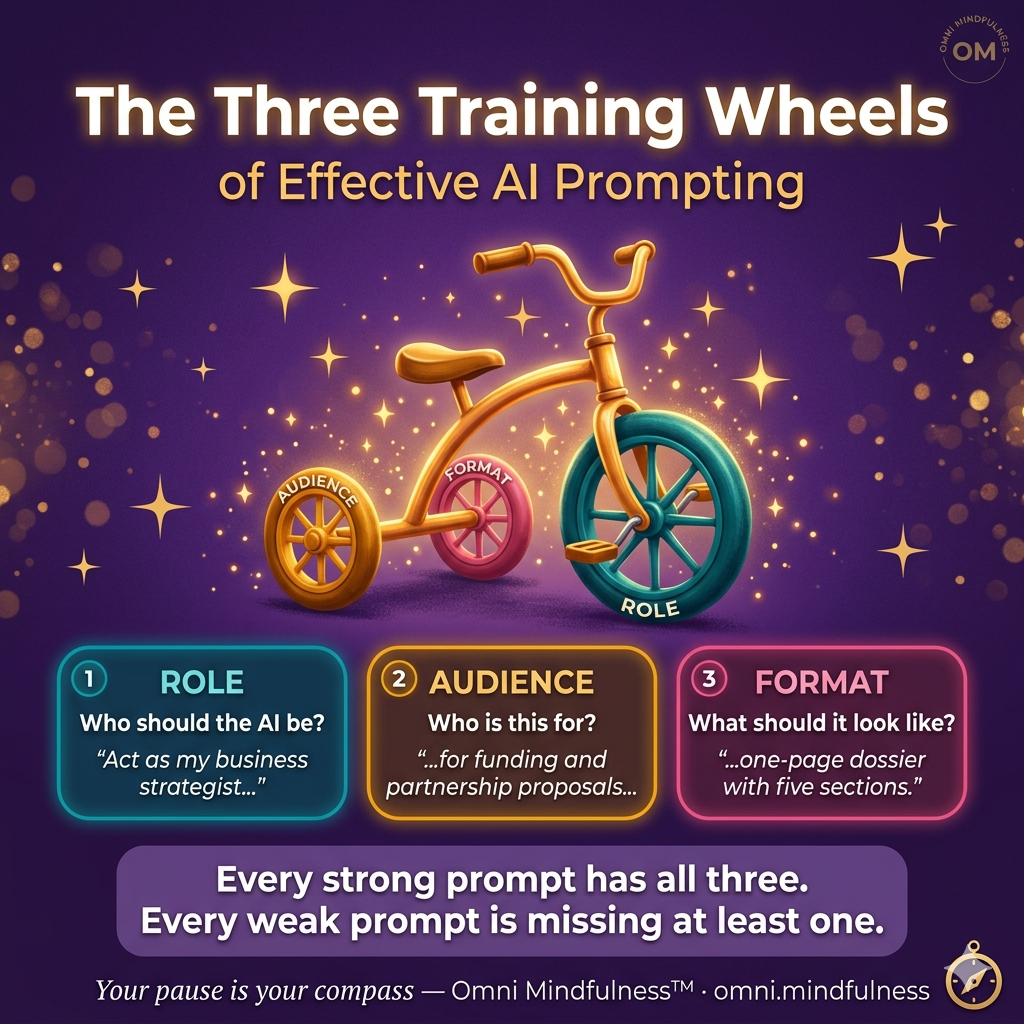
- Role. Who should the AI be for this task? Not “an assistant” — a strategist, a copywriter, a blunt editor, a skeptical customer. Naming the role tells the AI which expertise to draw from, the same way you’d brief a specific person differently than you’d brief a generalist.
- Audience. Who is this actually for? A prompt aimed at “funding and partnership proposals” produces something entirely different from one aimed at a casual social caption, even if the underlying topic is identical. Vague audience produces vague tone.
- Format. What should this actually look like when it’s done? A one-page dossier with five sections is a different deliverable than a bulleted list or a single paragraph — and most flat outputs happen because the AI had to guess at a shape nobody specified.
Every strong prompt has all three wheels. Every weak one is missing at least one — and it’s almost always the same one you’d guess, if you stopped to check.
(See the graphic: “The Three Training Wheels of Effective AI Prompting” — the visual version of this practice, built from the same workshop worksheet, distilled to what I actually use.)
Try This Today — One Prompt, Three Questions, One Real Problem
When I text my husband, he knows it’s me before he’s even finished reading — the rhythm, the shorthand, the things only I’d say. Your audience deserves that same recognition reading your public posts. Role, audience, and format will get you close. But there’s a layer underneath all three that a quick drill can’t reach — what if the AI actually knew your voice, trained on your real work instead of described fresh every time? That’s a different gap than this letter closes. More on that soon.
With that in mind, here’s what the AI Prompting Tricycle actually looks like in practice — not three separate exercises, but three questions asked of one real problem at the same time.
A client came to me feeling invisible, and it turned out why: she was stunned to learn her own past clients didn’t realize she offered a full holistic lifestyle package. They only saw the nutrition piece — one pillar of a much bigger offering, mistaken for the whole thing.
I audited her platforms and handed her one prompt, not a strategy deck:
“Act as a social media strategist. I want to reach women 35+, working moms who are striving to feel more balanced, who are in overdrive and overwhelmed and don’t have time to dig for the full picture. Write short-form content that helps them notice my whole holistic lifestyle offering — not just the nutrition piece — even if they’re scrolling past in five seconds. Keep it built for the platforms where they’re already spending time.”
One prompt. Three wheels, answered together, for one real problem:
- Role — social media strategist, not “content writer” or “assistant.” That’s whose judgment gets borrowed.
- Audience — not “my followers.” Women 35+, working moms, in overdrive, short on time. Specific enough that generic wellness copy stops being an option.
- Format — short-form, built for scroll-speed, on the platforms those women are actually already on. Not a blog post nobody had time to open in the first place.
The insight underneath all three: her problem was never “post more.” It was that no single piece of content she’d ever published named the whole picture — the AI couldn’t have known that without being told, and neither could a stranger scrolling past her feed.
That’s the whole practice: one real challenge, three questions asked of it at once — not three unrelated drills. A habit that closes the gap between being skilled and being seen as the expert you are.
Frequently Asked Questions
- Do I need to learn prompt engineering to do this? No. Prompt engineering as a specialized skill is mostly unnecessary for founders — what actually moves the needle is the same clarity you’d bring to briefing a real person, applied consistently. The AI Prompting Tricycle is a habit, not a technical skill.
- What if I don’t know what “good” looks like yet? That’s normal, and it’s exactly what step five is for — ask the AI to ask you clarifying questions before it creates anything. You don’t need the full picture before you start; you need enough to give it something real to work with.
- Does this only work with ChatGPT? No — the same three wheels apply to any large language model: Claude, Gemini, or anything else. The mechanism (specific input produces specific output) is a property of how these tools work generally, not a quirk of one platform.
- Isn’t this just common sense? Mostly, yes — and that’s the point. The barrier was never intelligence or technical skill. It was that nobody had named the gap out loud, so it stayed invisible even to people using these tools every day.
- How is this different from a generic prompt template I could find online? Templates hand you someone else’s context. The AI Prompting Tricycle is a practice you run yourself, every time, with your own real role, audience, and format — which is exactly why it holds up across completely different situations instead of only working for the one example a template was built around.
This is part of an ongoing series on Overcoming AI Overwhelm. For the human side of this same conversation — what AI still can’t do for you, no matter how clear your prompt is — see The Human Skills AI Can’t Touch.
The Close
That crashed thread in 2023 didn’t mean I’d broken something. It meant I hadn’t yet learned to bring the same clarity to a keyboard that I’d bring to a real conversation — and neither had almost anyone else that year. The tools have gotten better since then. But the actual fix was never really about the tools. It was about a habit so small it fits on three wheels, practiced enough times that it stops feeling like a technique and starts feeling like how you naturally think before you ask for anything — of a machine, or a person.
Next time you open a chat window, pause for the length of one breath. Name the role. Name the audience. Name the format. That’s the whole practice — and it’s the difference between an answer you delete and one you actually use.
Your pause is your compass. — Shilpa 🦋