
The Discernment Filter — a one-page keep-or-cut map.

Right now, as I write this, I have five browser windows open. Two or three ChatGPT threads. Claude in one—while Claude Desktop runs beside it. Perplexity. NotebookLM, now Gemini’s. And Gemini, my buddy for images.
A normal Thursday.
A meditation teacher whose screen looks like this.
The irony and I are on a first-name basis.
If yours looks anything like mine, you know the feeling: not behind, exactly. Just holding a lot—every tab quietly certain it’s the most important thing.
Key Takeaways
- AI overwhelm isn’t a tool problem or a discipline problem. It’s a discernment problem.
- More input—more tools, more trainings, more prompts—doesn’t create clarity. It buries what actually matters.
- Discernment, choosing what actually matters, is the human advantage AI can’t hand you.
- Discernment tells you what to cut. It doesn’t tell you where to put what’s left—what you keep needs a container.
- That container was never meant to be built alone.
Inside Amplify You™ Club, we turn AI overwhelm into a clear, practical plan for building the visibility and authority you already have the expertise for.

The Problem
The noise doesn’t run on one track. It comes from several directions at once: AI trainings, because the tools shift daily; articles; newsletters. Each one is useful on its own. All of them together become a firehose you can’t drink from and still hear yourself think.
And it’s never been easier to add one more AI tool.
This week, I’m mapping a full 90-day plan for a client, and AI drafted the scaffolding in minutes. That’s the quiet trap: the plan was never the hard part. Knowing what actually matters inside it is.
More consuming, more collecting, more starting—and less and less actually moving. That’s not a discipline failure. It’s what happens when input outpaces the space available to process it.
The Evidence
You already know more than enough to do your work well. What you don’t get is a quiet minute to hear yourself think.
Microsoft’s 2025 Work Trend Index found that employees in the highest-volume group of Microsoft 365 users were interrupted by a meeting, email, or chat roughly every two minutes during core work hours—amounting to 275 interruptions across a full day.
That’s the real shape of overwhelm: not a shortage of information, but a shortage of uninterrupted room to think your own thoughts.
The noise isn’t outside you anymore. It’s the tab you open out of habit before you’ve finished the one in front of you.
The Solution
There’s a Sanskrit term for this kind of clarity: viveka—the ability to distinguish what actually matters from what only feels urgent.
AI can help you gather, compare, and organize information. But it cannot decide what matters most to you, your work, or the thing you’re trying to build. That decision gets more valuable—not less—the more tools you own.
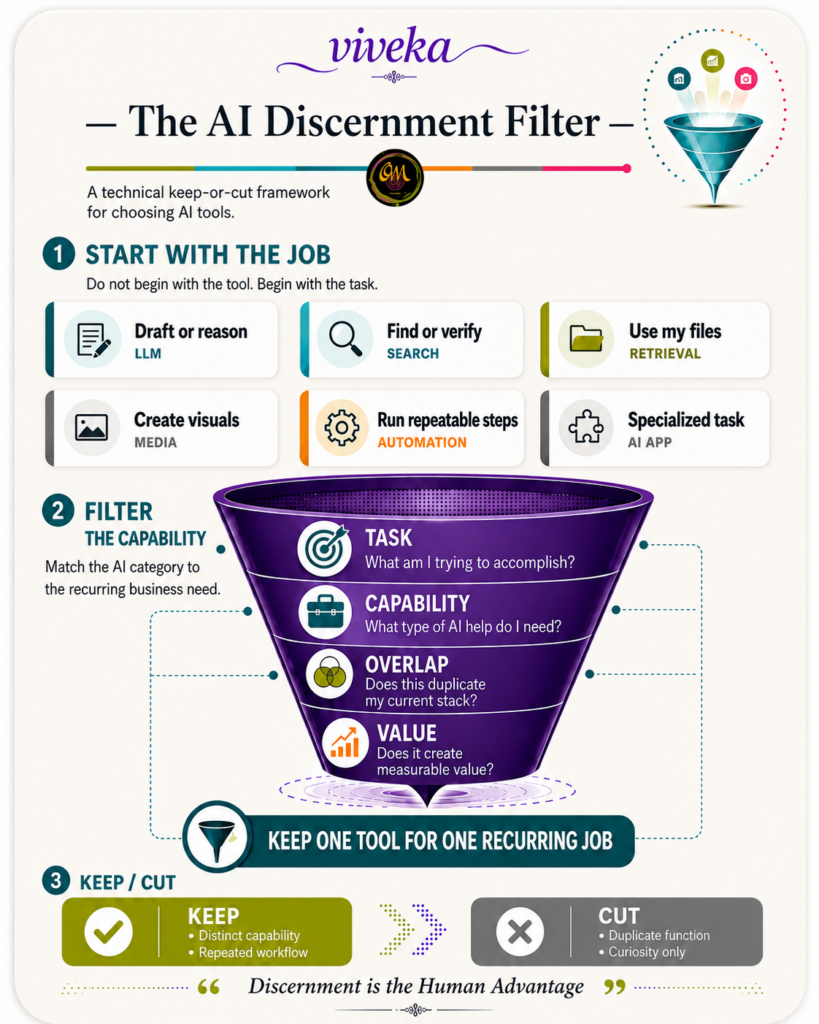
Discernment sounds like a question you ask before opening the next tab:
Does this actually serve the one thing I’m building, or does it just add to the noise?
That question is why I switched Perplexity back to free, went deeper with the one tool that earns its place, and MacGyvered a client’s email-deliverability fix with Manus—free—when her messages were silently bouncing before they ever reached an inbox, instead of hiring a specialist.
Not less for less’s sake.
Choosing.

But here’s the part discernment can’t finish alone: it tells you what to cut, but it doesn’t give the signal you keep somewhere to live.
And the reason the scatter comes back, week after week, usually isn’t a lack of willpower. It’s that you’re holding all of it by yourself, with no room that reflects your work back to you so you can see it clearly.
Clarity, it turns out, is not a solo sport.
That “somewhere to put it”—a place that holds your one signal and the people building alongside you—is what the Amplify You™ Club is for.
Not another tool.
The container the tools were missing.
Practical Steps
- Run the filter. Before you open or buy anything, ask: Does this serve the one thing I’m building, or does it simply add to the noise?
- Go deeper, not wider. One tool you actually know how to use beats five tools you only skim.
- Cut paid tools when free does the job. Discernment about spending is still discernment.
- Name the one thing you’re building. You can’t filter toward a target you haven’t named.
- Stop building the container alone. Find the room where your work can be held, witnessed, and reflected back to you.
Frequently Asked Questions
Isn’t using fewer tools just falling behind?
No. Depth beats breadth. The person who knows one tool deeply may get more value from it than the person juggling six tools superficially. Keeping up was never the job.
How do I know which tools to cut?
Run the filter question against each one. If a tool doesn’t serve the one thing you’re building, it may be noise wearing a subscription.
I’m not technical. Does this still apply?
Yes. This isn’t primarily about AI fluency. It’s about discernment—and you already have that capacity. It may simply be buried under the noise.
Where do I actually start?
Name the one thing you’re building. Then stop trying to hold it all alone.
The Close
The noise isn’t going anywhere. There will always be one more tool, one more training, one more tab.
Clarity was never going to come from closing all of them. It comes from knowing the one thing they’re all supposed to serve—and having somewhere, and someone, to help you keep it.
Next week: the one thing all this choosing is meant to protect—your signal—and how to name it.

Your pause is your compass. — Shilpa 🦋
This is part of an ongoing series on Overcoming AI Overwhelm.